

BLUF: Bottom Line Up Front
The U.S. defense industry encompasses a diverse ecosystem of companies – from aerospace manufacturers and shipbuilders to software firms and professional services contractors – all contributing to national security. To succeed, these businesses must clearly articulate their mission and capabilities online. A modern website optimized for both traditional search (SEO) and Answer Engine Optimization (AEO) is critical for visibility, ensuring government agencies and AI-driven search tools can discover and evaluate their offerings.
Introduction – Overview of the Defense Industrial Base
The U.S. Defense Industrial Base (DIB) is the extensive network of organizations, facilities, and resources that provide defense-related materials, products, and services to the government. This includes not only the big-name weapons manufacturers but thousands of specialized suppliers and service providers. In fact, the defense industry’s scope extends far beyond weapons or hardware – it involves technology companies, software firms, construction and engineering contractors, logistics and maintenance providers, cybersecurity specialists, intelligence analysts, and professional services organizations. If a business supports military readiness, national security, intelligence operations, or defense infrastructure, it is part of the defense industrial base.
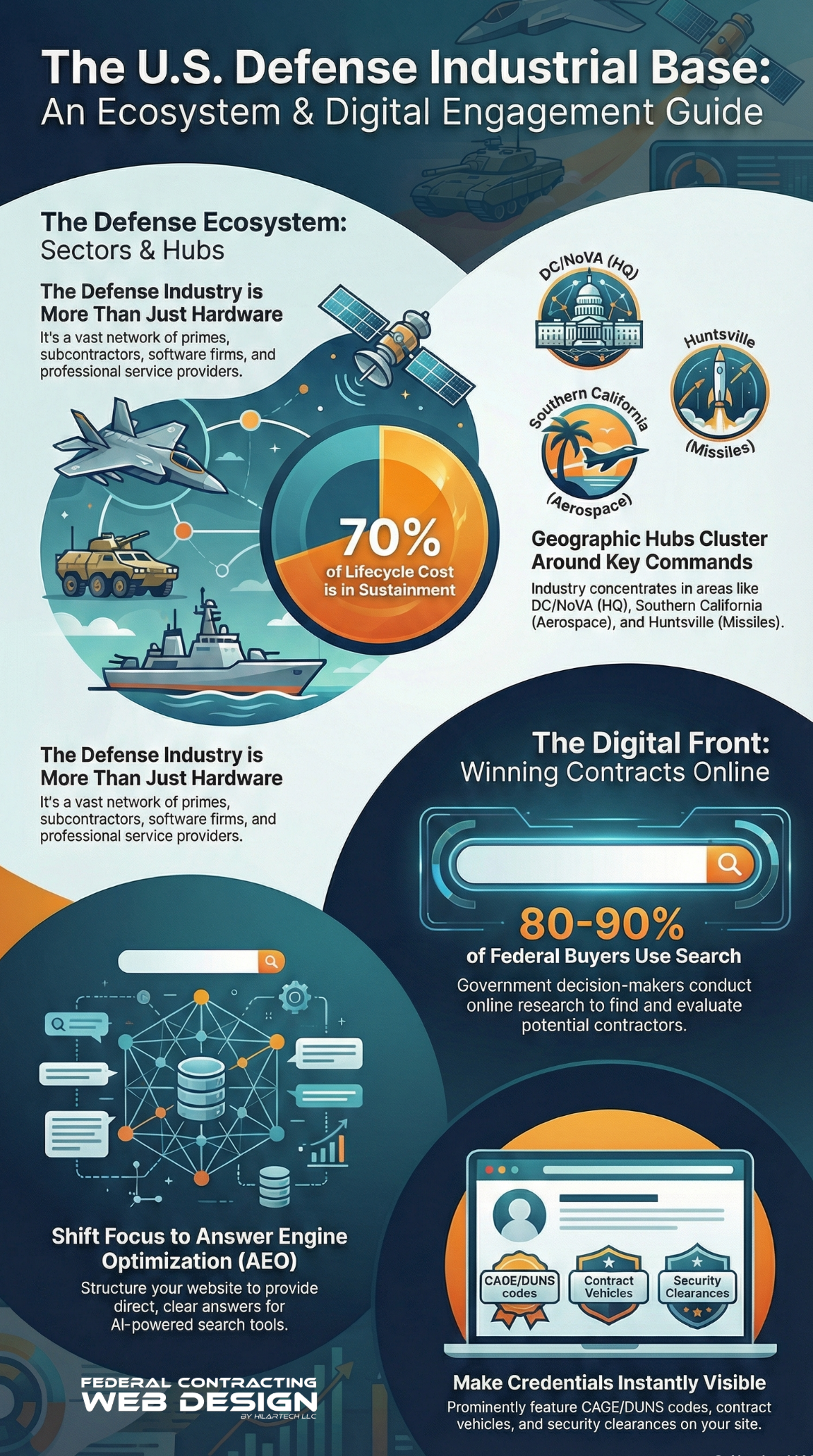
Understanding the major lines of business in this industry is crucial for grasping how different companies contribute to defense missions. It’s equally important for these companies to effectively communicate their capabilities. Government procurement officials and prime contractors often conduct market research via online search; roughly 80–90% of federal decision-makers use search engines to find products and vendors. Increasingly, they are also leveraging AI tools and “answer engines” to get information. This reality makes a strong online presence – optimized for both human readers and AI algorithms – a business necessity in the federal marketplace.
Major Lines of Business in Defense Contracting
The defense sector comprises a wide variety of business types, each fulfilling different mission-critical roles. Below is an in-depth look at the primary lines of business, from the primes at the top of the supply chain to the niche players providing specialized services.
2.1 Prime Defense Contractors
Overview:Prime contractors are the large, lead companies that contract directly with the Department of Defense (DoD) to deliver major systems or programs. These firms – think of giants like Lockheed Martin, Boeing, Northrop Grumman, General Dynamics, and RTX (Raytheon Technologies) – design, develop, and integrate complex platforms such as fighter aircraft, warships, armored vehicles, satellites, and missile defense systems. They manage extensive networks of subcontractors to assemble these systems and often hold long-term sustainment and upgrade contracts for their products. Primes are responsible for delivering complete solutions to the government and typically oversee program management, systems engineering, and integration of all components.
Large prime contractors stand at the apex of a deep supply chain. For example, a company like Lockheed Martin might rely on thousands of suppliers for a single program – at one point, an estimated 75% of the cost of Lockheed’s F-16 fighter was paid out to subcontractors for parts and sub-systems. The top five defense contractors (Lockheed, Boeing, Raytheon (RTX), General Dynamics, Northrop) collectively receive a majority of DoD contract dollars each year.
In FY2022, DoD spent $415 billion on contracts, and these five firms alone accounted for a large share of those obligations, underscoring their outsized role as primes. Prime contractors not only produce cutting-edge hardware (e.g. the F-35 Lightning II jet or Virginia-class submarines), but also often develop software and C4ISR systems, provide training and support, and serve as integrators bringing together numerous technologies into a cohesive capability.
2.2 Subcontractors and Tier Suppliers
Overview:Sitting just below the primes are the many subcontractors, suppliers, and tier-two or tier-three vendors that actually produce a substantial share of defense products. These companies range from large subcontractors that build major components (e.g. an engine manufacturer or radar supplier) to small machine shops, electronics providers, software developers, and specialized engineering firms. Most defense work, by volume, is performed by this extended supply chain. Subcontractors provide everything from precision-machined parts and wiring harnesses to advanced software modules, subsystems, and testing services. Many are highly specialized, focusing on niche domains (for example, a company might only produce composite materials for aircraft wings, or encryption modules for communications systems). They often operate behind the scenes of major programs, delivering their piece of the puzzle to the prime contractor.
The relationships in this layer can be extensive. A single missile or aircraft might have hundreds of subcontracted suppliers contributing. For instance, Northrop Grumman’s work on the historic MX Peacekeeper missile relied on over 500 subcontractors providing 19,000 parts. AlliedSignal (now part of Honeywell), a top-25 defense contractor in the 1990s, was reported to depend on 7,500–10,000 suppliers, which made up 60% of its defense contract costs.
These figures illustrate that subcontractors collectively form the backbone of the defense industrial base. They tend to operate in the background and can be more vulnerable to market fluctuations (a prime’s program delay can directly impact all its suppliers). However, their expertise is critical – whether it’s a manufacturer of high-temperature engine turbine blades or a small business writing software for an aircraft avionics update.
2.3 Aerospace and Aviation Companies
Overview:This category covers companies involved in military aircraft, spacecraft, and related aviation systems. It includes the prime contractors for airframes (like Boeing and Lockheed Martin on fighters or transports) and extends to numerous specialized firms that provide aerospace subsystems or entire aircraft in niche areas. Aerospace companies build fixed-wing aircraft (fighters, bombers, transports, tankers), rotorcraft (helicopters and tiltrotors), and unmanned aerial systems (drones), as well as satellites and launch vehicles for military and intelligence missions. Their work spans airframe design and manufacturing, propulsion systems (jet engines, rocket motors), avionics and sensors, flight control software, and testing and flight training support. Many also engage in maintenance, repair, and overhaul (MRO) of aircraft fleets. A subset focus on space – designing military communications or GPS satellites, launch services, or human spaceflight components.
Aerospace and defense have long been intertwined; the U.S. aerospace sector is a major economic driver. California and Washington have historic aerospace industries (think of Boeing’s roots in Seattle, or the Southern California legacy of building jets and spacecraft since WWII). Today, military aerospace programs include the F-35 Joint Strike Fighter (built in Fort Worth, TX), the new B-21 Raider stealth bomber (Palmdale, CA), advanced drones like the MQ-9 Reaper (San Diego, CA), and a variety of rotorcraft.
Space-related firms like SpaceX and United Launch Alliance provide launch capabilities for DoD satellites, while traditional defense firms produce the satellites themselves (Lockheed, Boeing, Northrop, and smaller ones like L3Harris for sensors). In summary, aerospace companies enable control of the skies and space – from the fighter jets securing air superiority to the satellites enabling GPS and communications.
2.4 Cybersecurity and Information Technology Firms
Overview:Modern military operations hinge on secure networks and robust IT infrastructure. Cybersecurity and IT firms in the defense sector provide the tools and services that protect information systems, communications, and data at all classification levels. These companies do everything from developing secure network architectures and cloud services for the DoD, to actively monitoring and responding to cyber threats targeting military systems. Key offerings include implementing zero-trust security frameworks, managing identity and access control, encrypting data and communications, and running Security Operations Centers (SOCs) for threat detection and incident response. Many such firms also specialize in offensive cyber or signals intelligence support for U.S. Cyber Command and NSA.
Additionally, this category covers general IT support: data center management, software development, enterprise IT helpdesk services, and migration of legacy systems to the cloud. Big defense-oriented IT integrators like Leidos, General Dynamics Information Technology (GDIT), and CACI fall here, as do specialized cybersecurity providers and numerous smaller 8(a)/small businesses.
Secure cloud computing is a major focus – exemplified by the DoD’s JWCC cloud contract involving multiple commercial cloud vendors to host sensitive data in hardened environments. Cybersecurity firms work closely with intelligence agencies to ensure U.S. networks are defended against constant attacks (the DoD has recorded tens of thousands of cyber incidents over recent years).
2.5 Intelligence, Surveillance, and Reconnaissance (ISR) Providers
Overview:ISR providers are companies that support the collection, processing, and analysis of intelligence for the military and intelligence community. Their work enables commanders to “see and understand” the battlefield or area of interest, often in real time. This broad category includes building and operating sensor platforms – such as reconnaissance aircraft, drones, and satellites carrying cameras, radars, or signal intercept equipment – as well as developing the ground systems that process the data (imagery, signal intelligence, etc.) and analytic software that helps interpret it. Some ISR firms specialize in electro-optical or infrared sensors for aerial surveillance, others in radar systems (like SAR – synthetic aperture radar), and others in signals intelligence (SIGINT) payloads.
On the services side, many companies provide intelligence analysis support: teams of analysts with security clearances who pore over data feeds (from drones, satellites, wiretaps, etc.) and extract actionable insights. These contractors often work on-site at agencies like the NGA, NSA, or service intelligence centers, augmenting government intel analysts. A growing sub-segment focuses on data fusion and artificial intelligence – developing AI algorithms that can scan through vast intelligence data to flag threats or patterns.
Example: Project Maven was a DoD initiative using AI to identify objects in drone video, executed in part by contractors. In the field, ISR also involves contractors who deploy with or for military units to operate specialized sensors (for instance, contractor pilots flying surveillance aircraft or maintaining ground surveillance radars).
2.6 Software, Data, and Artificial Intelligence Companies
Overview:This line of business comprises companies that develop software and data solutions for defense – essentially, the digital backbone and brains behind military operations. These firms build everything from command-and-control software that military leaders use to orchestrate forces, to logistical systems that track supplies, to modeling and simulation software for planning and training. Many are now heavily involved in artificial intelligence (AI) and machine learning (ML) projects for the DoD: for example, algorithms for predictive maintenance, AI for analyzing drone footage or satellite images, decision-support tools that can war-game scenarios, and autonomous system software.
Unlike traditional defense hardware companies, software and data-centric firms may have more of a commercial tech background. Some notable examples: Palantir provides data integration platforms used by the Army and others; Booz Allen and Deloitte have analytics teams working on AI for defense; smaller startups (through DIU or AFWERX programs) are bringing innovations like cybersecurity AI or maintenance optimization tools.
A critical piece of this category is enterprise IT and cloud software – migrating legacy defense systems to modern cloud-based applications. Companies in this space often operate in denied/disconnected environments too – meaning they design software to work even with limited connectivity or hardened security, which is a military requirement.
2.7 Communications and Networking Providers
Overview:Communications and networking providers enable the secure voice, data, and video communications that connect all levels of the military – from soldiers on the front lines up to the Pentagon. These companies develop and supply everything from tactical radios carried by troops, to satellite communication (SATCOM) systems that can beam data globally, to the networking equipment that links sensors, shooters, and commanders in real time. Key products and services include: software-defined radios and waveforms, satellite terminals and services (e.g. KU-band, MILSATCOM), encryption devices for secure links, ruggedized network routers, and 5G/next-gen wireless technologies.
Many companies in this area are working on the DoD’s vision of JADC2 (Joint All-Domain Command and Control) – a resilient, meshed network connecting Air, Land, Sea, Space, and Cyber domains. This involves traditional defense comms firms (e.g. L3Harris, Collins Aerospace, Viasat) and commercial tech players (e.g. Nokia, Ericsson, SpaceX’s Starlink). A major challenge is making comms “warfighter-proof” – ensuring equipment works in contested environments with electronic jamming and cyber attacks.
Communications providers also run base telecommunications, big exercise networks, and maintain the Defense Information Systems Network (DISN). Some focus on deployable comms kits for disaster relief or special operations, where rapid setup of secure, resilient links is mission-critical.
2.8 Logistics, Sustainment, and Maintenance Companies
Overview:Logistics and sustainment companies handle the vital tasks of keeping the military running – managing supply chains, maintaining equipment, and providing operational support over the long haul. Often overlooked in favor of weapons systems, sustainment is where a majority of defense dollars are actually spent. Key players include large integrators like KBR, PAE (now Amentum), and the services divisions of Lockheed Martin and Boeing, alongside thousands of specialized small businesses. Their work spans procurement of spare parts, depot-level maintenance (overhauling major platforms at shipyards and logistics centers), field support teams, and global transportation of munitions, fuel, and supplies.
Life cycle management is the guiding principle here. From the moment a system is fielded until its retirement decades later, these firms ensure it remains operational. This includes Performance-Based Logistics (PBL) contracts, where contractors are incentivized based on platform availability rates, and Base Operations Support (BOS), where companies manage entire military installations – from power plants and dining facilities to vehicle fleets and warehouses.
A critical benchmark in this sector is that approximately 70% of a weapon system’s total life-cycle cost is incurred during sustainment and operations, not the initial acquisition. This highlights the immense importance of readiness and "uptime" in national defense strategy.
2.9 Training, Simulation, and Human Performance Firms
Overview:These companies focus on preparing military personnel for real-world operations through training systems, simulators, and programs to enhance human performance. Key products include high-fidelity flight simulators (full-motion cockpits replicating fighter jets or helicopters), weapon system trainers (virtual tanks or ship bridges), and mission rehearsal simulators for practicing complex maneuvers in virtual environments. This sector is also pioneering immersive VR/AR tools for infantry marksmanship and technical maintenance training.
On the services side, firms provide critical training program support: designing curricula, running live exercises as opposing forces (OPFOR), and managing combat training centers. Human performance optimization is a specialized niche focused on physical resilience, psychology for Special Operations Forces, and biofeedback technology to improve cognitive performance under stress.
The Orlando, Florida area is the primary global hub for this sector, hosting major simulation commands for the Army and Navy. Companies like CAE and L3Harris lead the market, emphasizing that simulation provides massive cost savings—a flight hour in a physical F-35 is exponentially more expensive than a high-fidelity simulator session.
2.10 Construction, Engineering, and Infrastructure Contractors
Overview:The Defense Department relies on a vast physical infrastructure—bases, ports, airfields, training ranges, laboratories, hospitals, and more. Construction and engineering contractors build and maintain this backbone. This category includes major international firms like Clark Construction, Fluor, and Bechtel, alongside specialized engineering firms. Projects range from traditional vertical construction (barracks, hangars) to heavy civil works like runways and ship piers. Many projects are unique to defense: hardened blast-resistant facilities, secure SCIFs for intelligence work, and high-tech cyber operations centers with redundant power and cooling.
Beyond construction, these firms handle environmental engineering (munitions cleanup), energy resilience (solar farms and microgrids on installations), and Base Realignment and Closure (BRAC) support. Some contractors even support combat engineering in contingency operations, building base camps in austere overseas environments.
This sector is primarily funded through Military Construction (MILCON) budgets, which exceeded $18 billion in FY2024. This funding supports hundreds of critical projects globally, ensuring that U.S. forces have the necessary facilities to operate in places like Guam, Poland, and across the domestic landscape.
2.11 Professional Services and Advisory Firms
Overview:Not all defense contracting is about tangible hardware or IT systems – a substantial portion involves professional services to support the management and operations of defense agencies. These firms provide expertise in areas like program management, acquisition support, policy analysis, financial management, legal and compliance consulting, and strategy advisory. In essence, they help the government plan and execute programs, adhere to regulations, and improve processes. Examples include assisting a Program Executive Office (PEO) in managing its portfolio of contracts, providing subject matter experts to draft policies or analyze threat scenarios, or helping an agency implement new regulations such as procurement reform or CMMC cybersecurity rules.
Many of these companies are consulting firms (e.g., Booz Allen Hamilton, which is a top defense contractor primarily through professional and IT services; or smaller 8(a) consultancies providing niche expertise). They often work side by side with government employees in offices as "contractor support staff." While their roles are strictly advisory to avoid blurring the line with inherently governmental functions, their presence is significant—it’s common that in a given Pentagon office or command staff, a number of contractors are embedded to handle workload.
Specific services include: contracting and acquisition support (drafting RFPs, Evaluating proposals), logistics and supply management consulting, budget and finance support (tracking expenditures), regulatory and safety compliance, and strategy and wargaming (conducting studies to inform DoD strategy).
2.12 Research and Development Organizations
Overview:R&D organizations in the defense context are companies (and also non-profits or university-affiliated labs) that work on advanced concepts and emerging technologies for the military. They are essentially pushing the envelope of innovation, developing future capabilities that may not be fielded for years. These include specialized tech startups, defense prime R&D divisions like Lockheed’s Skunk Works, and University Affiliated Research Centers (UARCs). Research domains span hypersonic weapons, directed energy (lasers), quantum technology, autonomous systems, and advanced biodefense.
The U.S. leverages dedicated funding mechanisms like DARPA (Defense Advanced Research Projects Agency) and the military services' own laboratories (AFRL, ONR). Programs such as Small Business Innovation Research (SBIR) grants are vital for bringing startup-driven innovation into the defense ecosystem. These contractors focus on building prototypes, developing lab-environment algorithms, and providing deep analytical studies where high-risk/high-reward outcomes are the norm.
Unlike production-heavy primes, many R&D firms focus almost exclusively on proving technical concepts. Once a technology matures, it is often adopted by a larger prime contractor for industrial-scale manufacturing, highlighting the collaborative and iterative nature of defense technology development.
Top Defense Industry Hubs and Installations in the U.S.
Defense activity in the United States is geographically concentrated around certain key regions that host multiple military bases, command headquarters, defense agencies, or large defense industry clusters. Below we highlight 20 of the top locations with a high density of defense installations and organizations forming critical nodes in the defense industrial base.
Washington, D.C. & Northern Virginia (National Capital Region)
The NCR is the administrative heart of the U.S. military. It contains the Pentagon (Arlington, VA), which is DoD headquarters, and a dense array of defense agencies and military service HQs. Nearby in Virginia are the CIA headquarters in Langley and the Office of the Director of National Intelligence, while in Maryland are NSA at Fort Meade and NRO at Chantilly, VA (just outside DC). This region hosts countless contractors targeting federal defense and intelligence agencies. Northern Virginia’s economy, in particular, is heavily defense-oriented with companies in cybersecurity, consulting, and systems integration supporting the Pentagon and intel community. (Notably, 87% of federal executives use online search in early market research per a study, reflecting how procurement officers in places like DC seek out firms digitally.) This area also includes Fort Belvoir, VA (home to agencies like Defense Logistics Agency), Andrews AFB, MD (Air Force One’s base), and more. In sum, the DC metro is unparalleled for headquarters and contracting offices – making it ground zero for defense contract opportunities.
Hampton Roads, Virginia (Norfolk/Virginia Beach region)
A major Navy and Marine Corps concentration. Naval Station Norfolk is the world’s largest naval base and home to the Atlantic Fleet. The area also has several other installations: Joint Base Langley-Eustis (Air Force fighters and Army Training and Doctrine Command), Naval Air Station Oceana (East Coast Master Jet Base), Naval Amphibious Base Little Creek, and Marine Corps Base Quantico (just north of the metro, hosting USMC Combat Development Command and FBI Academy). This region’s defense industry focuses on naval shipbuilding and repair (Newport News Shipbuilding builds nuclear carriers and subs), naval aviation, and fleet support services. It also hosts important commands like NATO’s Allied Command Transformation and U.S. Fleet Forces Command. Hampton Roads has one of the largest concentrations of uniformed personnel in the U.S., and its economy is deeply tied to defense. Key contractors here include Huntington Ingalls Industries (shipbuilding) and numerous maritime and logistics firms.
Orlando & the Space Coast, Florida
Orlando is known as the nation’s hub for military simulation and training. It hosts Army, Navy, and Marine Corps simulation program offices and the Air Force Agency for Modeling & Simulation. Virtually every major defense company has a presence in Orlando to support these efforts. Companies here build high-tech simulators, training software, and virtual reality systems for warfighter training. Just east of Orlando is Florida’s Space Coast – home to Cape Canaveral (Patrick Space Force Base) and Kennedy Space Center. This area hosts contractors involved in space launch operations, satellite R&D, and missile testing. For example, SpaceX and ULA conduct launches here, and companies like L3Harris (headquartered in Melbourne, FL) work on space and communications systems. Together, Central Florida’s defense industry includes Lockheed Martin and Northrop Grumman facilities and specialized firms serving both military simulation needs and NASA/Space Force missions.
Tampa Bay, Florida
Centered on MacDill Air Force Base in Tampa, which is headquarters to U.S. Central Command (CENTCOM) and U.S. Special Operations Command (SOCOM). This makes Tampa a strategic hub for operations in the Middle East and global special forces missions. A wide array of defense contractors cluster here to support CENTCOM and SOCOM requirements – including intelligence analysis, linguistic services, cybersecurity, logistics, and special operations equipment. Many former military personnel settle in Tampa and continue working as contractors, providing a skilled workforce. Notable defense-related employers include SOCOM’s numerous contracting offices and firms like Jacobs and Booz Allen providing support services. The presence of these commands means Tampa contractors often focus on areas like counterterrorism, regional cultural expertise, and technologies for special ops (from comms gear to tactical vehicles).
North Texas (Dallas–Fort Worth Metroplex) and Austin, Texas
The DFW area is a major aerospace and defense manufacturing center. Fort Worth hosts Lockheed Martin’s massive plant that builds the F-35 Lightning II fighter jets. Many subcontractors and suppliers for aerospace are spread throughout the Metroplex. Nearby, Dallas is home to Raytheon’s intelligence and space business, and L3Harris has a significant presence. The region also benefits from multiple bases in north/central Texas (Sheppard AFB, Dyess AFB, and Fort Hood a bit south) contributing to defense spending in the state. Meanwhile, Austin, TX (200 miles south) has emerged as a defense innovation hub – notably, the Army Futures Command was established in Austin to tap the tech startup culture. Austin’s tech ecosystem, including AI and software startups, intersects with defense through incubators and collaborative programs. Combined, Texas draws more Defense Department spending than any other state (as of recent years), driven by these large manufacturing programs and installations.
San Antonio, Texas
Nicknamed “Military City USA,” San Antonio has a massive military footprint with Joint Base San Antonio comprising Lackland AFB, Randolph AFB, and Fort Sam Houston. It’s a center for military training (Lackland hosts Air Force basic training), military medicine (Brooke Army Medical Center), and cybersecurity (Lackland is also home to Air Force Cyber Command). Contractors in San Antonio support everything from medical services and research to cyber operations. For example, the city hosts cybersecurity firms working with 16th Air Force (the cyber and ISR numbered Air Force) and companies providing simulation training at Randolph. With many veterans in the area and organizations like USAA (serving military families) headquartered here, the workforce is very tuned to defense. San Antonio’s clustering of missions – basic training, medical, cyber – creates steady contracting needs in those fields. Firms range from small professional service outfits to major integrators like Booz Allen.
Colorado Front Range (Colorado Springs & Denver area)
Colorado Springs is a key center for Air Force and Space Force operations. It hosts Peterson Space Force Base and Schriever SFB (Space Command units and control of GPS constellation), Fort Carson (Army), Cheyenne Mountain and NORAD/NORTHCOM HQ, and the U.S. Air Force Academy. Notably, U.S. Space Command (re-established) is temporarily headquartered here as well. The Springs has a heavy concentration of space and missile defense activity – numerous contractors work on missile defense programs, military satellites, and communications systems, making aerospace one of the city’s largest industries. Up the road, the Denver area hosts big aerospace company facilities like Lockheed Martin’s space systems headquarters in Littleton. Colorado’s mix of military units and industry means jobs in satellite engineering, missile defense engineering, and defense IT are plentiful. In addition, Boulder/Denver have NOAA and NIST labs that often partner with defense on research. The Front Range’s appeal also lies in its tech talent pool and the synergy of having military buyers and private sector developers in proximity.
St. Louis, Missouri
St. Louis has a rich aerospace and defense legacy and remains important especially in aviation. It’s home to Boeing Defense, Space & Security’s HQ and large production facilities – Boeing employs ~15,000 in the region, producing military aircraft like the F/A-18 Super Hornet and F-15 fighter, as well as missiles. The region also includes Scott Air Force Base across the river in Illinois, which hosts U.S. Transportation Command (USTRANSCOM) and Air Mobility Command. Contractors in St. Louis support USTRANSCOM’s logistics mission and work with the National Geospatial-Intelligence Agency (which has a major new campus in north St. Louis under construction). Beyond Boeing, defense firms here include General Dynamics (which has an IT office), Raytheon, and many smaller manufacturers particularly in aerospace electronics and ordnance. While some legacy programs have wound down (like the end of F/A-18 production on the horizon), the region continues to secure new projects (Boeing in St. Louis is building the new T-7A trainer jet for the Air Force). This mix of manufacturing and military transport HQs keeps St. Louis a significant defense hub.
Dayton, Ohio
Centered on Wright-Patterson Air Force Base, Dayton is a major hub for Air Force R&D and logistics. Wright-Patt is one of the Air Force’s largest bases and home to the Air Force Research Laboratory (AFRL), the Air Force Life Cycle Management Center, Air Force Materiel Command headquarters, and the National Air and Space Intelligence Center (NASIC). Because of this, Dayton has evolved into a high-tech defense R&D cluster. Contractors like Boeing, Northrop Grumman, and Lockheed have offices near the base to collaborate on Air Force technology programs. Local firms and university partners work on aeronautics engineering, sensors, materials science, and logistics systems for the Air Force. As heavy manufacturing declined in the region historically, defense R&D filled the void – the area boasts wind tunnels, labs for advanced materials, and testing facilities. The continuous stream of contracts for technology development and support services (from propulsion research to simulation) keeps Dayton’s economy tied strongly to defense. Additionally, nearby Springfield hosts a large Air National Guard intelligence unit and there’s a growing UAV research presence.
Atlanta/Marietta and Warner Robins, Georgia
The Atlanta metro benefits from proximity to several major installations. In Marietta (northwest of Atlanta), Lockheed Martin operates a plant building C-130J Super Hercules transport planes and doing F-35 subassembly – making Atlanta a key site for aerospace manufacturing. Just south of Atlanta, Dobbins ARB and Clay National Guard Center also contribute to the defense presence. Further south in Georgia is Robins Air Force Base (Warner Robins, GA), which houses a large Air Logistics Complex responsible for depot-level maintenance of aircraft and avionics. Robins AFB’s depot brings extensive contracting for sustainment work. Georgia also hosts Fort Moore (formerly Fort Benning) for infantry training and Fort Gordon (in Augusta) with the Army’s Cyber Center of Excellence and NSA-Georgia. In the Atlanta area, major defense contractors like General Dynamics, Raytheon, Pratt & Whitney have operations, as well as Glock’s U.S. headquarters (important for firearms in law enforcement and some military sales). While Georgia saw some declines in defense contracts after certain programs ended, the state remains significant for military aircraft production and sustainment, and Atlanta itself offers a large workforce and transportation hub that many contractors find advantageous.
Phoenix and Tucson, Arizona
Arizona hosts two notable defense industry hubs. Tucson has a long-standing aerospace and missiles cluster – it is home to Raytheon Missiles & Defense, which develops and manufactures a wide array of missiles (like the Tomahawk, Standard Missiles, AMRAAM, Sidewinder, etc.) and is one of the region’s largest employers. Over 80 aerospace and defense firms operate in the Tucson area, benefiting from the skilled workforce and proximity to testing ranges in the southwest desert. In Phoenix, the defense presence includes companies like Honeywell Aerospace (engines and avionics) and a growing electronics and communications tech sector. Northern Phoenix has facilities for manufacturing rocket motors (Northrop Grumman has a large site in Chandler for missile defense interceptors, for example). Arizona’s Luke AFB (west of Phoenix) is a major pilot training base (F-35 training) which also brings contractors to support operations. Yuma Proving Ground and Davis-Monthan AFB (Tucson) contribute additional activity. In summary, Tucson specializes in missiles/space and Phoenix in aviation and electronics, giving Arizona a balanced defense industry. The state’s dry climate and open space make it ideal for testing and training, further bolstering defense work.
Southern California (Los Angeles & San Diego)
Southern California has been a defense powerhouse since WWII. San Diego is one of the country’s largest military centers: it hosts Naval Base San Diego (homeport to much of the Pacific Fleet surface ships), Marine Corps Base Camp Pendleton, Marine Corps Air Station Miramar, and other installations. San Diego’s defense industry spans shipbuilding/repair, unmanned systems, cyber, and even biotech (medical research for military). The presence of the Naval Information Warfare Systems Command (NAVWAR) in San Diego means a lot of C4ISR and cyber contracts in the area. Northward, Los Angeles (and adjacent areas like El Segundo and the Antelope Valley) form an aerospace hub. Los Angeles AFB (now part of Space Force as Space Systems Command) in El Segundo directs many military space programs. Contractors like Northrop Grumman, Boeing, and Lockheed Martin have major facilities in the region working on satellites, rockets, and advanced aircraft. For instance, Northrop’s plant in Palmdale is building the new B-21 Raider stealth bomber. SoCal also has a huge defense talent pool (engineers and scientists), partly due to decades of aerospace presence and top universities. While defense is a smaller share of California’s vast economy today (~1% of state GDP) than during the Cold War, it remains critical in these metro areas. Key focuses: San Diego for Navy/Marine operations and unmanned tech, LA for space and aircraft development.
Huntsville, Alabama
Known as “Rocket City,” Huntsville is a significant and growing defense and space hub. It is home to Redstone Arsenal, which hosts the Army’s Materiel Command, the Army’s Space and Missile Defense Command, the Missile Defense Agency (MDA), and NASA’s Marshall Space Flight Center – an extraordinary concentration of space and missile programs. Huntsville has major offices for Boeing, Lockheed Martin, Raytheon, Northrop Grumman, and others, all co-located to work on programs like the Patriot missiles, NASA’s SLS rocket, and a variety of Army aviation and missile projects. In 2023, the Air Force selected Huntsville as the preferred permanent headquarters for U.S. Space Command (though that decision became subject to political review). The region’s synergy of Army, NASA, and incoming Space Command missions means a unique blend of military and civilian space technology. Huntsville’s talent pool of engineers (originating from the Apollo program days) and its relatively low cost of living make it attractive for contractors. Redstone’s expansion (FBI is also moving significant workforce there) diversifies the federal presence. Alabama overall has made defense a priority sector, with the state actively supporting growth in Huntsville’s defense industry. In summary, Huntsville provides unparalleled access to key federal space and missile programs, and contractors there work on everything from interceptor missiles to spacecraft design.
Seattle & Puget Sound, Washington
The greater Seattle area combines a strong defense industry with significant military installations in the Puget Sound. It’s historically the home of Boeing’s commercial operations, but Boeing Defense also has presence and suppliers in the region. Just outside Seattle, Naval Base Kitsap (Bangor) is home to the Pacific Fleet’s Trident nuclear submarines, and the Puget Sound Naval Shipyard (Bremerton) overhauls carriers and subs – generating shipyard and marine engineering contracts. Further south, Joint Base Lewis-McChord (JBLM) near Tacoma is a large Army/Air Force base. JBLM hosts I Corps and special operations units, driving needs for logistics and training support contracts in that area. The Pacific Northwest defense scene is somewhat smaller than other regions, but key focuses include naval undersea warfare (Naval Undersea Warfare Center Division Keyport is in the area), IT and cyber (the region’s tech-savvy workforce has spawned some cyber defense small businesses), and continuing aerospace work (Boeing’s P-8 Poseidon maritime patrol aircraft are built in Renton, WA, for example). Also, Seattle’s proximity to Pacific theaters and Arctic routes is strategically important, likely sustaining military interest.
Omaha, Nebraska
Omaha might seem out of place, but it’s home to Offutt Air Force Base, which hosts U.S. Strategic Command (STRATCOM). STRATCOM is responsible for nuclear forces, global strike, and missile defense integration. The presence of STRATCOM means a concentration of contractors dealing with command and control systems, nuclear command communications, and advanced planning software. Offutt is also home to the 55th Wing (which flies recon aircraft like the RC-135), and it had the former Air Force Weather Agency. Contractors in Omaha (and across the river in Bellevue, NE) often support STRATCOM’s IT and analysis needs. Companies like Northrop and Perspecta have had contracts for maintaining STRATCOM’s systems. While not large in number of firms, the contracts here can be highly technical and critical due to the nuclear mission.
Fayetteville, North Carolina
Fayetteville is adjacent to Fort Liberty (formerly Fort Bragg), which is one of the largest military bases by population. Fort Liberty is the home of the 82nd Airborne Division, the XVIII Airborne Corps, and U.S. Army Special Operations Command (USASOC) – including elite units like the Green Berets and Delta Force. The base also hosts the Joint Special Operations Command (JSOC). Because of this, the area’s defense contracting revolves around special operations support, airborne and infantry equipment, training support, and force sustainment for rapidly deployable units. Contractors may provide services like role-player support for training exercises, maintenance of the extensive base facilities, and R&D on soldier systems (weapons, parachutes, communications gear for special forces). Fayetteville’s economy is heavily military-driven; while it doesn’t have big defense manufacturing, it has many small businesses fulfilling niche needs for the Army and SOCOM.
Honolulu, Hawaii
Honolulu (and Oahu island) is the strategic fulcrum of U.S. forces in the Indo-Pacific. Joint Base Pearl Harbor-Hickam is a major Navy and Air Force hub (headquarters of U.S. Pacific Fleet and Pacific Air Forces). Marine Corps Base Kaneohe Bay and Army Schofield Barracks (home of 25th Infantry Division) are also on Oahu. The U.S. Indo-Pacific Command (INDOPACOM) headquarters is at Camp Smith overlooking Pearl Harbor. As a result, Hawaii has a robust defense contracting scene primarily oriented around Pacific operations. This includes contracts for Navy ship repair at Pearl Harbor Naval Shipyard, construction and base support (Hawaii receives substantial MILCON funds for facilities), and lots of exercise support and logistics given the many joint exercises with allies that occur in Hawaii. Companies here often provide services like range operations (e.g., at Pacific Missile Range Facility on Kauai), IT and communications support for PACOM headquarters, and cultural/language expertise for engagement with Pacific nations. Being remote from the mainland, Hawaii’s contractors also handle unique challenges like providing housing services, power and utilities management, and even things like invasive species control on training ranges. Defense is a huge part of Hawaii’s economy, second only to tourism.
Boston & New England (Massachusetts and Connecticut)
The New England region is a significant center for defense R&D and high-tech manufacturing. Around Boston, there are major defense research labs (MIT Lincoln Laboratory, MITRE) and many companies focusing on advanced electronics, cybersecurity, and communications for the Air Force and other agencies. Raytheon (now RTX) was headquartered in Massachusetts and still has a large footprint there working on radars, missile defense systems, and electronic warfare gear. The Boston tech ecosystem (plus its universities) feed innovation into defense – the Pentagon even set up an outpost of its Defense Innovation Unit (DIU) in Boston to leverage the startup scene. Meanwhile, in Connecticut, there is a heavy concentration on military engines and submarines. Pratt & Whitney in CT builds jet engines for fighters and mobility aircraft. Sikorsky (in Stratford, CT) makes Black Hawk and CH-53K helicopters. And General Dynamics Electric Boat in Groton, CT, builds nuclear submarines (Virginia and Columbia-class). These make Connecticut one of the most defense-dependent state economies (over 7% of CT’s GDP is defense-related). New England also has Portsmouth Naval Shipyard in Maine (overhauling submarines) and the U.S. Navy’s NUWC Newport in Rhode Island (undersea warfare R&D). Collectively, the region’s strength is in engineering and innovation – many cutting-edge technologies in missiles, aircraft engines, and naval systems originate from its companies and labs.
Detroit/Warren, Michigan
The Detroit area, with its automotive heritage, plays a role in defense primarily through ground vehicle development and procurement. The U.S. Army’s Tank-automotive and Armaments Command (TACOM) is located in Warren, MI, along with the Tank Automotive Research, Development and Engineering Center (TARDEC, now DEVCOM GVSC). As a result, this area oversees Army ground vehicle acquisition and R&D. Major defense contractors like General Dynamics Land Systems (maker of Abrams tanks and Stryker vehicles) are in the Detroit suburbs. Oshkosh Defense (based in Wisconsin) also has a presence for coordinating with TACOM. Many automotive suppliers around Detroit contribute to military vehicle manufacturing (engines, armor, suspension parts, etc.). While not as large as some other hubs, the Detroit/Warren area remains the epicenter for U.S. military ground vehicle programs – any new tank, truck, or Humvee replacement goes through here, drawing contracting for engineering, testing, and production.
Charleston, South Carolina
Charleston has seen growth as a defense hub particularly in the IT and federal workspace domain. Joint Base Charleston includes an Air Base and a Naval Weapons Station. More significantly, Charleston is home to the Naval Information Warfare Center (NIWC) Atlantic, one of the Navy’s premier centers for C4ISR and IT systems acquisition. NIWC Atlantic (formerly SPAWAR Atlantic) contracts with many companies for software development, network engineering, and cybersecurity solutions for the Navy and Marine Corps. This has spawned a cluster of tech-oriented contractors in Charleston working on projects like shipboard networks, cybersecurity compliance, and communications systems integration. The metro also hosts some Coast Guard units and Army logistics commands. With a high quality of life and growing tech scene, Charleston has attracted defense-related businesses and some relocations of federal activity.
AI & AEO Optimization for Defense Contractor Websites
In the 21st-century federal marketplace, having a strong digital presence is no longer optional – it’s mission-critical. Government acquisition personnel increasingly rely on search engines and even AI tools to research industry capabilities before issuing solicitations. This means defense contractors must ensure their websites are search engine optimized (SEO) and ready for Artificial Intelligence “answer engine” optimization (AEO). Below are key guidelines and best practices for structuring a defense contractor’s website to maximize discoverability by both traditional search (Google) and emerging AI-driven search assistants.
1. Embrace Answer Engine Optimization (AEO)
AI-powered search engines (such as Google’s AI snippets, Bing’s ChatGPT-based results, and other chatbot-style query responders) scan content differently than a human would. They look for structured, concise answers and credibility signals. If a site isn’t optimized for these answer engines, the company becomes effectively invisible to procurement professionals relying on AI tools. To address this, contractors should incorporate content in formats that AI can easily digest – FAQ sections, Q&A formatted content, and clear declarative statements answering common government questions. For example, having a Q&A like “Q: Does Company X have experience with Air Force cybersecurity? A: Yes – Company X has provided cyber defense for USAF networks including …” can feed AI answers directly.
2. Use Schema Markup and Structured Data
Implementing schema.org structured data helps search engines understand content context. Adding schema for Organization (with DUNS/CAGE codes, small business categories), for Services, and FAQPage schema will directly feed information to AI algorithms. Structured data is like putting the content in a database format for the AI – e.g., marking up a contract vehicle list or NAICS code list in HTML that is machine-readable. This can increase the chance that an AI pulls your company info as a direct answer to a query like “8(a) contractor in radar engineering near me” or “SDVOSB with Navy cybersecurity experience Virginia”.
3. Develop Mission-Focused Landing Pages
Create dedicated landing pages for each key capability, customer, or mission area. For instance, specific pages for “Aerospace Systems Engineering” or “Cybersecurity for Defense” perform better than generic copy. Pages that speak directly to supporting particular agencies (e.g., “Supporting U.S. Air Force Logistics”) can capture long-tail searches and demonstrate deep Understanding of that niche. Government buyers often search specifically (“XYZ certification contractor Army base operations Germany”), and aligning pages to those niches increases relevance.
4. Write in Plain Language (Clarity over Jargon)
While defense is full of acronyms, your web copy should be clear and readily understandable to AI and human alike. Overuse of jargon or marketing fluff fails to communicate value. Lead with strong statements of capability (e.g., “Certified 8(a) contractor with Secret clearance”) followed by evidence like contract names or outcomes. The goal is to have sentences that could stand alone as an answer if excerpted by a chatbot.
5. Highlight Credentials and Compliance
Ensure the site prominently lists contract vehicles (GSA Schedule, IDIQs), socio-economic status (8(a), SDVOSB), CMMC level, ISO certifications, and facility clearance levels. These satisfy human checklists and make the site more likely to appear if those keywords are queried by AI scanning for credibility signals. Including past performance references (program names or agency customers) further signals authority to machine crawlers.
6. Mobile-Friendly and Fast
Technical SEO still matters. Government users may be on secure but possibly bandwidth-limited networks. A fast-loading, mobile-optimized site improves human access and factors into rankings. Check accessibility (Section 508 compliance) as proper headings and alt text help search engines parse content logically.
7. Incorporate FAQs and Direct Answers
AEO best practice is to have an FAQ section that explicitly answers common questions such as “Is Company X on GSA Schedule?” or “What contracts has Company X won?”. Such content, marked up properly, is like candy for answer engines – it’s structured, concise, and authoritative when specifics are included.
8. Emphasize Regional and Agency Keywords
Many contracting officers search including location or agency (e.g., “NAVSEA cybersecurity contractor”). If your business targets a specific command or base, mention it explicitly. Individual pages for each region (e.g., “Team Orlando – Modeling & Simulation”) serve as hyper-local landing pages built for mission niches, which AEO strategies recommend.
9. Keep Content Fresh and Updated
Government and AI alike favor sites with up-to-date information. Regularly update your site with news of contract wins, new capabilities, or thought leadership pieces. Stale content referencing old DoD programs reduces relevance. Ensure basic info (point of contact, DUNS/CAGE) is current so an AI can pull your contact line when queried.
10. Monitor and Adapt
Treat your digital presence as a living asset. Use AI chatbot platforms to see what queries your company appears in. Monitor your analytics for search queries and refine content as AI algorithms evolve. Failing to modernize means missing out on discovery in an increasingly digital procurement environment.
Conclusion & Key Takeaways
The defense industry is far more multifaceted than just weapons and warfighters. It spans from the factory floors building jets and ships, to the office parks where analysts, engineers, and coders solve complex problems for the military. We’ve broken down a dozen key segments – primes, suppliers, IT, cyber, logistics, and more – each playing a unique role in supporting national security. Understanding these categories is not only useful for comprehending how defense needs are met, but also critical for businesses to identify where they fit in the ecosystem and how to articulate their niche.
One clear theme is the interdependence: big primes rely on a vast network of smaller subcontractors for much of the actual work; high-tech advances rely on software and AI to get the most out of hardware; and sustaining the force (through training, maintenance, logistics) is as important as acquiring new systems. The U.S. military’s capabilities ultimately rest on this broad industrial and technological base working in concert.
Another key takeaway is the importance of visibility and communication. With top defense hubs spread across the country – from California to Florida, from Texas to Virginia – it’s evident that opportunities are nationwide and often concentrated around installations. Companies benefit from locating near these hubs or at least networking within their ecosystems. But beyond physical presence, digital presence has emerged as equally vital. Government stakeholders increasingly use web searches and AI tools to inform their decisions. A contractor that cannot be easily found online, or whose website fails to clearly convey capabilities aligned to a buyer’s needs, will be at a serious disadvantage in the competition for contracts.
In Summary:
The defense industrial base includes a wide spectrum of business types, all contributing to mission readiness – from those making the “big iron” of tanks and ships to those writing the code that secures networks, to those training troops or repairing equipment. Successful defense firms know their place in this ecosystem and make sure their mission and capabilities are clearly showcased to the right audiences. In today’s environment, that means not only excelling in your line of work but also excelling in how you present yourself – particularly on the web, where first impressions often form. By structuring websites for both SEO and AEO, defense companies large and small can ensure that when Uncle Sam goes looking for a solution, their name is on the radar (or better yet, at the top of the list).
Ultimately, the U.S. government and military are looking for partners who demonstrate competence, credibility, and alignment with mission needs. A well-crafted, content-rich website is like a digital capability statement that works 24/7 – it can capture attention, whether from a contracting officer researching market options or an AI-driven assistant compiling data. Investing in that digital presence is investing in your company’s future in the defense arena. The battlefield for contracts can be as competitive as any other – make sure your arsenal includes not just expertise, but also discoverability.
References & Sources
Government Accountability Office (2024). Defense Industrial Base: Initiatives Needed to Address Supply Chain Fragility.
U.S. Department of Defense (2022). Summary: Joint All-Domain Command & Control Strategy.
Federal Contracting Web Design (2025). Major U.S. Defense Contracting Hubs: Research Report.