
Systemic Operational Design in Defense
How a Defense Contractor Consultant Could Frame an Unconventional Solution for the U.S. Navy
The Strait of Hormuz is often discussed like a classic naval fight. That framing is too narrow, and it creates bad choices.
If this problem is treated like a traditional surface warfare contest, the answer becomes predictable. Send destroyers into the chokepoint, defend commercial shipping, intercept incoming threats, and absorb the operational risk. That may look decisive on paper, but in a narrow waterway with compressed reaction times, it places some of the most valuable naval assets in the world inside a kill box designed by the adversary.
That is exactly why Systemic Operational Design matters.
A defense contractor consultant presenting this to the U.S. Navy should not begin with platforms. They should begin with the system.
Iran does not need to defeat the U.S. Navy in a conventional sense to create strategic success. It does not need sea control in the traditional naval warfare meaning. It only needs to manipulate the behavior of the broader system around the Strait. That system includes global energy markets, commercial shipping companies, marine insurers, civilian crews, regional political signaling, and military decision cycles. If Iran can make passage through the Strait feel too dangerous, even temporarily, then it can generate global economic shock without winning a fleet engagement.
That is the real center of gravity.
The consultant’s message to Navy leaders should be clear. This is not primarily a problem of ship versus missile. It is a contest over perception, cost imposition, risk amplification, and systemic paralysis.
Iran’s method is simple and effective. Use low cost, deniable, expendable assets from coastal sanctuary. Explosive skiffs, Shahed drones, mines, and coastal launchers do not need perfect accuracy or persistent dominance. They only need to create enough uncertainty to raise insurance premiums, slow commercial movement, unsettle crews, and force outside powers into a costly defensive posture.
In other words, Iran is not trying to sink the U.S. Navy. It is trying to make the global economy flinch.
That means the U.S. Navy should not solve the problem by stepping deeper into the exact logic Iran wants to impose. A systemic approach asks a different question. Instead of asking how to defend a ship in the strait, ask how to redesign the environment so the threat system loses effectiveness.
That shift changes everything.
The Wrong Question Produces the Wrong Fleet Posture
A traditional operational mindset tends to ask how the Navy can survive and win inside the chokepoint. A systemic mindset asks whether the chokepoint should remain the main arena at all.
That distinction matters because every Arleigh Burke class destroyer committed to close transit defense is a high value answer to a low cost problem. It is an exquisite asset placed in a setting where the enemy benefits from proximity, clutter, ambiguity, and reaction speed. In a 21 mile wide waterway, the margin for error collapses. Seconds matter. Misidentification matters. Civilian maritime patterns matter. Cheap attacks become strategically expensive because they force the defender to stay perfect every time.
The consultant should explain to the Navy that Iran’s design is built around this imbalance. Tehran gains leverage by making the United States spend more, risk more, and expose more in order to protect a commercial flow that Iran only needs to disrupt briefly.
That is why a better solution is not simply stronger defense. It is systemic redesign.
Match Asymmetry With Asymmetry
The first principle of a systemic approach is simple. Do not answer cheap mass with precious concentration.
Instead of placing manned surface combatants at the front of the problem, the Navy and its partners should create a distributed autonomous screen. The purpose is not only surveillance. The purpose is to absorb ambiguity, create standoff, and deny easy access to commercial shipping.
A consultant could frame this as a layered autonomous barrier built from uncrewed surface vessels and allied low cost maritime systems. These vessels would operate as a persistent screen in and around transit lanes, extending sensing, creating early warning, and forcing hostile small craft to reveal themselves before reaching tankers.
This concept matters because it changes the exchange. Iran’s low end swarm tactics depend on getting close enough, fast enough, and ambiguously enough to overwhelm normal reaction cycles. A dense autonomous screen complicates that pathway. It gives the system more depth. It buys time. It moves the first point of contact away from the tanker and away from the destroyer.
That is the real value.
The goal is not to create a perfect shield. The goal is to force the adversary to confront a field of expendable, networked defenders instead of a handful of highly valuable manned ships. Cheap mass should be met by smarter mass.
For the Navy, this is not a retreat from power projection. It is an adaptation in force design logic.
Attack the Nervous System, Not Just the Weapon
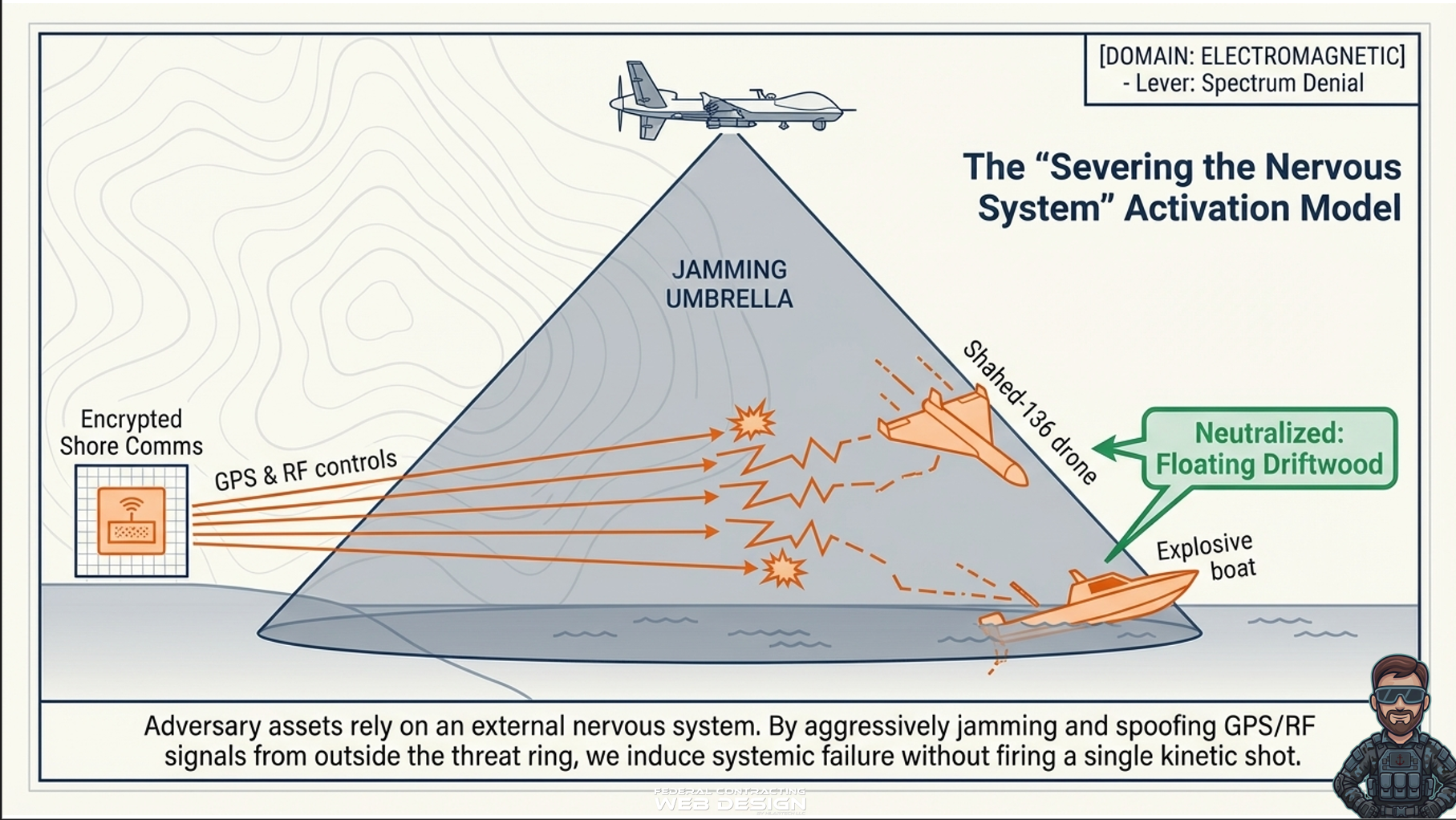
The second major argument a consultant should present is that Iran’s disruptive tools are only dangerous when their enabling links remain intact.
Explosive boats, one way drones, and distributed coastal threats are not isolated weapons. They are nodes inside a larger control system. They depend on positioning, targeting, communications, and timing. That means the U.S. response does not need to focus only on destroying every skiff or every drone. It can focus on degrading the environment those systems need in order to function.
This is where cognitive and electromagnetic severing becomes powerful.
Instead of chasing every contact in a cluttered maritime picture, the United States and its partners could impose spectrum denial across critical zones of the Strait. High altitude systems, stand off electronic warfare assets, and regional airborne platforms could disrupt the signals that hostile skiffs and drones rely on for navigation, control, and coordination.
The beauty of this approach is that it attacks dependency rather than inventory.
Without reliable wayfinding, remote control, or local command connectivity, many low cost attack systems become ineffective. Their threat value collapses before impact. Some become blind. Some lose cohesion. Some become little more than noise in the water.
That is what systemic warfare looks like. You do not need to destroy every tool if you can break the logic that allows those tools to matter.
For a Navy audience, this argument is compelling because it reduces the need for constant kinetic engagement. It shifts the burden from endless interception to environmental control.
Force the Adversary to Waste Its Arsenal
Iran’s strategy works best when it can preserve capability while creating fear. That means one of the smartest responses is to force expenditure without strategic gain.
A consultant could describe this as a decoy, deplete, and expose framework.
Rather than pushing only vulnerable commercial traffic through the most threatened areas, allied actors could employ autonomous decoy vessels or hardened unmanned barges that mimic the signatures of high value merchant shipping. Their purpose would not be transportation. Their purpose would be provocation and exposure.
If Iran takes the bait, it pays a price. It expends missiles, drones, or explosive craft against targets that do not produce economic disruption. Worse for Tehran, those launches reveal patterns, positions, and nodes that were previously concealed.
This is the operational trap.
By forcing the enemy to act against low value decoys, the United States gains intelligence, identifies launch architecture, and creates opportunities for precise stand off response from assets that never need to enter the most dangerous part of the waterway.
This shifts the burden back onto Iran. Instead of holding its tools in reserve while the world reacts to uncertainty, it must either waste them or lose psychological pressure. Either way, the system begins to turn against it.
For Navy decision makers, the value of this concept is that it creates initiative. It changes the force from reactive escort posture to active disruption of the adversary’s own design.
Devalue the Geography
One of the strongest points a consultant can make to the Navy is that not every strategic problem should be solved inside the tactical space where it appears.
The Strait of Hormuz only matters because so much energy traffic still depends on it. That means the geography has leverage because the surrounding system gives it leverage. Remove some of that dependence and the chokepoint becomes less decisive.
This is where a systemic bypass becomes essential.
The consultant should recommend immediate coordination with regional partners to maximize the use of overland and alternate export routes. Pipelines that move oil around the Strait do more than preserve flow. They directly reduce the strategic value of Iranian coercion.
That matters because the more energy that can be rerouted, the less powerful the threat of maritime disruption becomes. Iran’s ability to shake markets depends on the perception that it can choke supply. If enough supply keeps moving by alternate paths, that perception weakens.
This is not a purely economic measure. It is a military shaping measure.
It tells the Navy that not every maritime crisis is solved by putting more ships into danger. Sometimes the most effective naval strategy is helping create conditions where the geography itself loses bargaining power.
That is a serious shift in thinking, and it is exactly the kind of insight Systemic Operational Design is meant to produce.
Redesign the Insurance Problem
Another point many military plans miss is that the blockade effect is not only enforced by weapons. It is enforced by economics.
Commercial captains, insurers, and shipping executives are part of the battlespace whether military planners acknowledge it or not. If insurers withdraw war risk coverage and civilian crews refuse passage, the Strait can be functionally disrupted without a single large scale naval engagement.
That means the consultant should tell the Navy that the problem is partly financial architecture, not just maritime defense.
A sovereign indemnity model could be one answer. If the United States and allied governments provide a backstop for transiting vessels, then one of Iran’s most effective levers weakens. Commercial operators gain confidence to continue movement. Panic loses traction. The economic paralysis that Tehran seeks becomes harder to trigger.
That indemnity could also be tied to defensive conditions. Ships that receive coverage could temporarily accept modular counter drone or electronic protection systems, making each transit more resilient and reducing dependence on direct Navy escort.
This is a critical insight. It moves part of the defense burden from the fleet to the commercial ecosystem itself.
For Navy leaders, this is attractive because it preserves maritime flow without requiring a permanent concentration of warships in the highest risk zone. For the broader alliance, it spreads the solution across governments, insurers, and industry rather than pretending the Navy alone can solve a system wide coercion campaign.
What a Consultant Should Tell the U.S. Navy
If this were being presented to Navy leadership, the consultant’s core message should sound something like this:
The Strait of Hormuz is not simply a naval passage under threat. It is a tightly coupled economic, psychological, and military system being manipulated through low cost coercion. Iran’s objective is not fleet victory. Its objective is systemic disruption. Therefore, the U.S. response should not center on placing high value manned combatants into the adversary’s preferred engagement design. It should center on redesigning the system so Iran’s methods no longer generate the same leverage.
That means five things.
That is a strategy built to alter system behavior, not simply survive within it.
Why This Matters
The Navy is entering an era where many of its hardest problems will not look like fleet battles from the past. They will look like blended contests of ambiguity, economics, deniable violence, infrastructure pressure, and cognitive shaping. In those contests, the side that understands the system best often gains more than the side that simply brings the strongest platform.
That is the real value of Systemic Operational Design.
It helps leaders see that some threats are designed to lure powerful institutions into expensive, predictable responses. It helps them recognize when the visible battlefield is only a small piece of the real contest. And it helps them build solutions that do not merely fight the problem, but strip the problem of its leverage.
For the Strait of Hormuz, that is the argument a strong defense contractor consultant should make to the U.S. Navy.
Do not just defend the chokepoint.
Redesign the system that gives the chokepoint its power.
Strategic Brief
Hormuz Systemic Blueprint
Download PDF
Intelligence Briefing
"Iran is not trying to sink the U.S. Navy. It is trying to make the global economy flinch."
Related Intelligence
Financial Analysis
The Hidden Fee Game Behind GoDaddy, Hostinger, Wix, and Similar Platforms
Operational Trust
The Other Guys vs HILARTECH Hosting
Strategic Analysis
The Hard Truth Behind the FY27 Defense Budget Surge
Operational Trust
The Defense Contractor Website Test No One Talks About