
Terafab Austin: Elon Musk's Initiative Reshaping U.S. Defense & AI
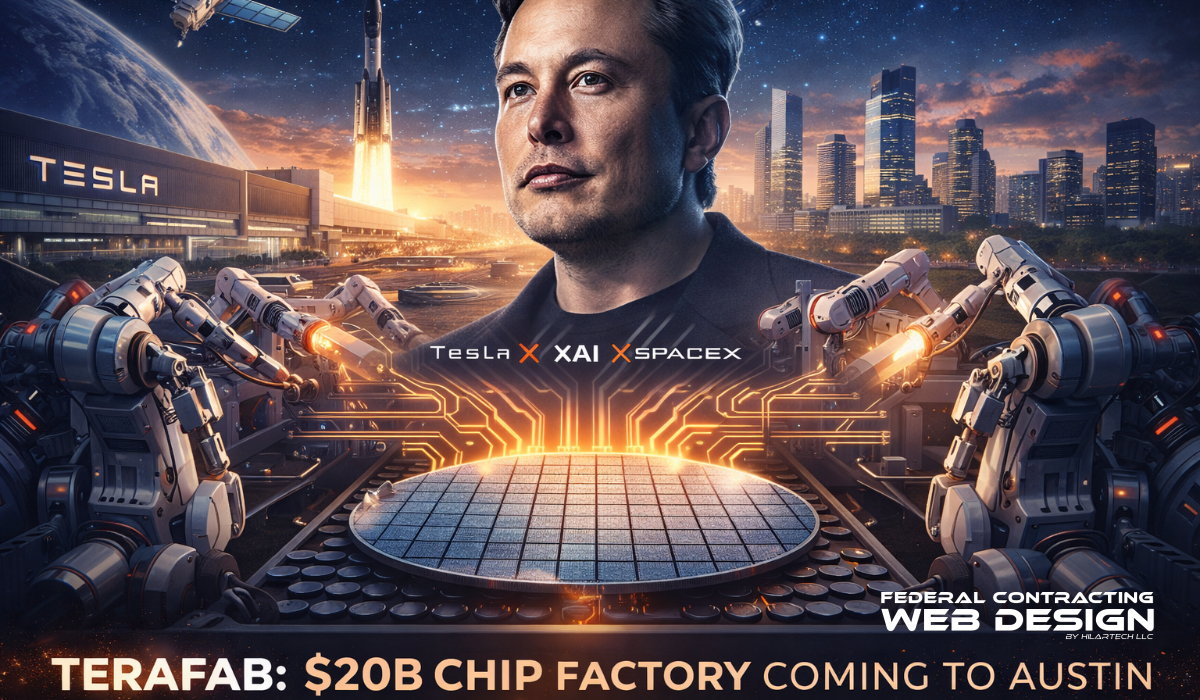
Elon Musk’s reported Terafab project in Austin is not just another factory announcement. It is a warning shot to every company building in AI, robotics, autonomy, aerospace, and defense. If the project delivers even part of what has been claimed, it will push compute closer to the center of industrial strategy itself. The companies that control compute production will gain leverage over cost, design speed, supply chain risk, and product tempo. Everyone else will be forced to move at someone else’s pace. Reports this week describe Terafab as a chip manufacturing effort tied to Tesla, SpaceX, and xAI, based at Giga Texas, with ambitions measured in tens of billions of dollars and compute output at enormous scale.
The headline number is what grabs attention. Multiple reports say Terafab is a roughly $20 billion project coming to the Austin area, while some coverage has floated a higher figure. The common thread across the reporting is not the exact number. It is the scale of intent. This is being framed as a major push to manufacture chips for AI, robotics, autonomous driving, and space related systems rather than staying fully dependent on outside semiconductor foundries.
That is the part smart contractors, suppliers, and industrial strategists should study closely.
This is not a chip story only
Terafab matters because compute is turning into the bottleneck for everything that now claims to be intelligent, autonomous, or software defined. AI models need it. Humanoid robotics need it. Self driving systems need it. Space based data and sensing architectures need it. Advanced autonomy programs do not scale on branding. They scale on compute, packaging, power, thermal design, process control, and sustained output. The Verge reported Musk describing Terafab as urgent because AI growth is straining chip supply, while Axios reported a target of producing 1 terawatt of computing power annually, with much of that vision tied to future deployment in space.
That shifts the strategic question.
For years, many companies treated compute like rented infrastructure. Buy the chips. Buy the cloud. Buy more capacity later. That logic starts to break when compute availability becomes the main governor on product speed. At that point, owning more of the compute stack changes the entire operating model. It changes cost structure. It changes development speed. It changes procurement leverage. It changes how fast one company can iterate against another. That is why vertical integration here matters so much more than a normal expansion story. It is about reducing dependence on external chokepoints.
Vertical integration at a different scale
The real significance of Terafab is not that a major company wants to build more chips. It is that the reported model aims to pull logic, memory, and advanced packaging into one manufacturing ecosystem. That would represent a much tighter form of vertical integration than simply signing bigger supply deals with outside fabs. Some details remain media reported rather than formally published in a technical program document, so they should be treated carefully. But the direction is clear. Musk is signaling that future control belongs to companies that do not leave compute production entirely in someone else’s hands.
That matters even more when the end markets are Tesla, SpaceX, and xAI style programs. These are not passive consumers of semiconductors. They are building systems that depend on dense compute for autonomy, inference, control, simulation, training, sensor fusion, and increasingly, real time decision support. A compute constrained company slows across all of those fronts at once. A company with more control over supply can move faster across all of them at once. That is why Terafab should be read as an industrial speed play, not only a manufacturing play.
Why this matters to defense and deep tech
Defense contractors should not dismiss this as a commercial tech story.
Modern defense is moving toward autonomy, edge compute, software defined platforms, onboard AI, robotic teaming, resilient space architectures, and higher rates of production for systems that used to be treated as exquisite and scarce. That means compute capacity is becoming a strategic dependency for defense relevant companies too, even when the fab itself is not a defense program. A project like Terafab signals where industrial gravity is moving. It favors companies that think in terms of integrated capability stacks, not isolated components.
The lesson is blunt. If compute becomes the limiting factor, then the company that controls more compute supply can control more of the development timeline. That does not mean every defense contractor should build a fab. It means they should understand the new hierarchy. Chips, packaging, process engineering, equipment, advanced materials, thermal systems, facility infrastructure, industrial automation, supply chain legal support, and capex execution are not back office support functions in this environment. They are strategic enablers. Tesla’s own job postings reflect that buildout logic, with current Terafab roles including Module Process Engineer in Austin, Silicon Module Process Engineer, Senior Counsel for Supply Chain, and Senior Counsel for Infrastructure and CapEx.
The hiring tells you where the pressure is
Job postings are often more revealing than glossy announcements.
Tesla’s published Terafab listings show active recruiting for process engineering and legal infrastructure functions tied directly to the project. The Austin based Module Process Engineer role is public. The Silicon Module Process Engineer listing describes work across lithography, etch, deposition, epitaxy, metals, implant, polish, and metrology and inspection. The legal roles centered on supply chain and infrastructure point to a program that expects complex commercial, buildout, and sourcing pressure from the start.
That is the deeper signal.
Terafab is not being staffed like a thought experiment. It is being staffed like an industrial program that will live or die on integration discipline. Process integration. Module engineering. Infrastructure. Supply chain. CapEx. Those are execution terms. They tell you this effort is less about announcing a future and more about assembling the people needed to build one. Tesla also has a Terafab Process Integration Engineer posting, though that role is listed in Palo Alto rather than Austin, which suggests some of the engineering stack may be distributed across locations even if Austin is the manufacturing center of gravity.
What the market should learn from this
Most companies still talk about innovation as if innovation ends at the prototype.
That mindset is weak.
Terafab is interesting because it treats manufacturing scale as part of the product advantage. In a compute hungry world, controlling more of the production path does not just improve margin. It improves tempo. It improves resilience. It improves bargaining power. It reduces the risk of waiting in line behind bigger customers at external foundries. It gives the builder more influence over the design to production loop. That is where real leverage starts to form.
For contractors, suppliers, and industrial firms, this creates a second order effect. Buyers and partners will increasingly look for companies that understand how their piece fits into a compute first industrial ecosystem. That could mean semiconductors directly. It could also mean clean power, thermal management, packaging materials, fab automation, secure facilities, industrial cyber controls, logistics, advanced inspection, metrology, or legal and commercial support around large scale infrastructure. The point is not that everyone becomes a chip company. The point is that more companies will now be judged by whether they help remove friction from compute dependent production environments.
The HILARTECH angle
This is exactly where most industrial and defense companies fail online.
They treat the website like a digital brochure while the market is moving toward capability ecosystems, faster teaming, and tighter industrial narratives. A project like Terafab raises the bar for how serious companies need to present themselves. If your company helps on process control, packaging, infrastructure, automation, supply chain law, robotics, AI hardware, or advanced manufacturing, your website should not bury that behind generic language. It should show where you fit, what friction you remove, and why a fast moving program should trust you. That is not cosmetic. That is business development support. That is capture support. That is strategic positioning. This inference follows directly from the types of roles now being hired and the scale of the project being discussed.
Companies that understand this shift will stop marketing themselves as broad solution providers and start positioning themselves as critical enablers inside a compute constrained world. Companies that miss it will keep sounding generic while the market moves around them.
Bottom line
Terafab is not just about Austin. It is not just about Musk. It is not even just about chips.
It is about the fact that compute is becoming a strategic terrain. The company that controls more of that terrain gains control over speed, cost, and dependency. If the reported Terafab vision becomes even partially real, it will reinforce a larger truth already taking shape across AI, robotics, space, and autonomy: production control is becoming development control. And the firms that understand that first will shape the next wave of industrial power.
References & Market Signals
- The Verge: Musk's Terafab Chip Plant
- Axios: Elon Musk Terafab AI Chip Manufacturing
- Tesla Careers: Module Process Engineer - Terafab
- Tesla Careers: Silicon Module Process Engineer - Terafab
- Tesla Careers: Process Integration Engineer
- Tesla Careers: Sr. Counsel, Supply Chain - Terafab
- Tesla Careers: Sr. Counsel, Infrastructure and CapEx - Terafab
Strategic Implications
Compute is turning into the bottleneck for everything that now claims to be intelligent, autonomous, or software defined.
- Owning more of the compute stack changes the entire operating model, cost structure, and development speed.
- Compute capacity is becoming a strategic dependency for defense relevant companies too.
- Production control is becoming development control.
Related Intelligence
Financial Analysis
The Hidden Fee Game Behind GoDaddy, Hostinger, Wix, and Similar Platforms
Operational Trust
The Other Guys vs HILARTECH Hosting
Strategic Analysis
The Hard Truth Behind the FY27 Defense Budget Surge
Operational Trust
The Defense Contractor Website Test No One Talks About