
The Student Became the Teacher: How Ukrainian PATRIOT Crews Are Reshaping U.S. Air Defense Doctrine
"They took to it like fish to water. In fact, we are now learning from their employment techniques." — General Christopher G. Cavoli, Supreme Allied Commander Europe & Commander, U.S. European Command, testimony before the House Armed Services Committee, April 2025
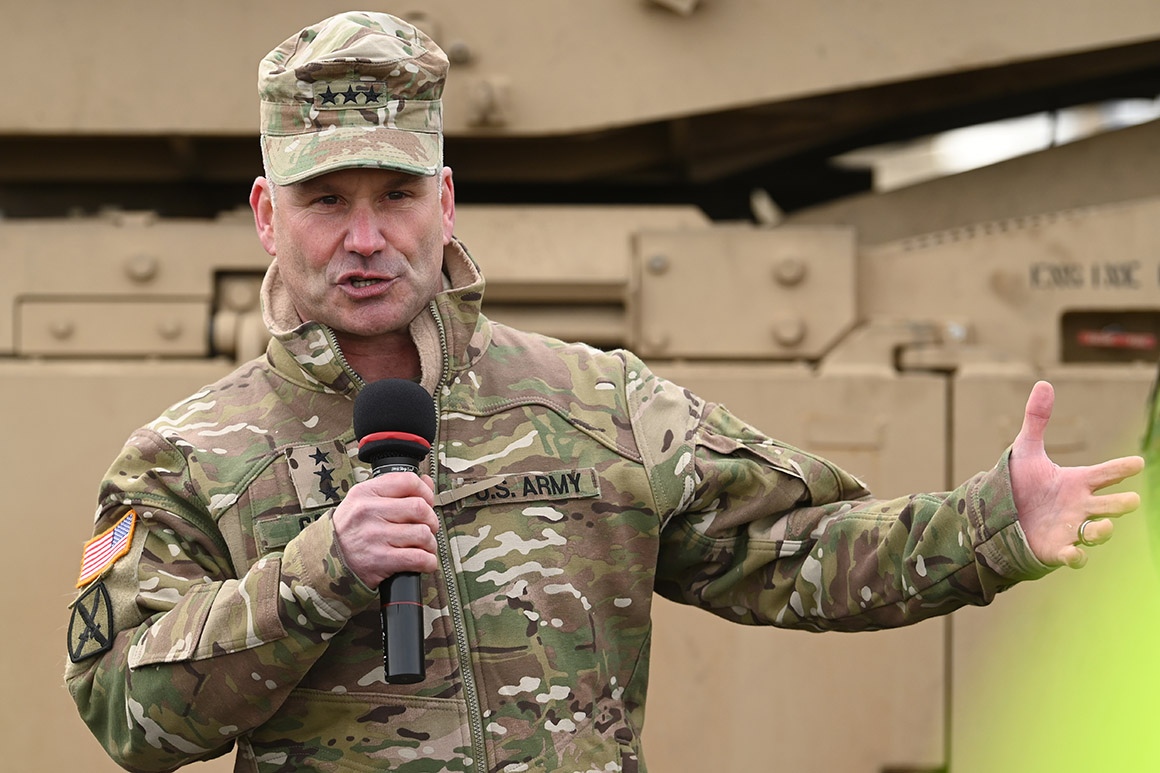
Bottom Line Up Front: The United States Army is not training Ukrainian PATRIOT crews. Ukrainian PATRIOT crews are training the United States Army. That is not rhetorical flourish. That is the stated position of America's top general in Europe. In April 2025 testimony before both the House and Senate Armed Services Committees, General Christopher G. Cavoli — Supreme Allied Commander Europe and Commander of U.S. European Command — delivered what may be one of the most striking admissions in recent American military history: Ukrainian operators have become so proficient with the MIM-104 PATRIOT air defense system that the U.S. Army is now formally studying their employment techniques. Cavoli, who admitted initial skepticism about whether Ukraine could master such a complex system under wartime conditions, said those doubts were quickly extinguished. The Ukrainians, he noted, put their very best people on the system — and those people figured it out under fire. This is a story about what happens when necessity, talent, and combat pressure collide. It is also a warning — and an opportunity — for how Western militaries think about doctrine, training, and the real cost of battlefield ignorance.
The System They Were Handed
To understand why this is extraordinary, it helps to understand what Ukraine was given.
The MIM-104 PATRIOT — Phased Array Tracking Radar to Intercept on Target — is among the most sophisticated air and missile defense systems ever fielded. Manufactured by Raytheon, it integrates a powerful phased-array radar with layered interceptor missiles capable of engaging aircraft, cruise missiles, ballistic missiles, and — as Ukraine has now demonstrated — hypersonic weapons once considered effectively un-interceptable.
Mastery of the PATRIOT system typically requires years of institutional training. The United States Army trains dedicated crews for extended periods under controlled conditions before those operators are considered combat-ready. The system's complexity is not incidental — it is a feature of its capability. Managing simultaneous multi-threat engagements, operating the AN/MPQ-53 radar under electronic warfare pressure, sequencing interceptors across multiple kill chains — these are skills that take time to build.
Ukraine did not have time.
When Ukrainian troops began training at Fort Sill, Oklahoma in early 2023, the clock was already running. Russian missiles and drones were hitting Ukrainian cities with regularity. The training window was compressed. The expectations, at least among outside observers, were modest.
What Actually Happened in the Skies Over Ukraine
The moment Ukraine's PATRIOT batteries went operational, they entered a combat environment with no equivalent in the modern world.
Russian strike campaigns against Ukraine have grown in scale and sophistication throughout the conflict. By mid-2025, Russia was launching an average of over 125 Shaheed-type drones per day, up dramatically from earlier in the war. Ukrainian air defenses were simultaneously contending with cruise missiles, ballistic missiles including the Iskander-M and Kh-47M2 Kinzhal, and increasingly sophisticated saturation attacks designed to overwhelm radar systems and exhaust interceptor stockpiles. No training range replicates this. No exercise produces these conditions.
And yet, Ukrainian PATRIOT crews delivered. In May 2023, Ukrainian operators achieved what had never been done before: the confirmed intercept of a Russian Kinzhal hypersonic missile over Kyiv — the first verified hypersonic missile intercept by any air defense system in history. Pentagon officials confirmed the engagement. It was a watershed moment, not just for Ukraine, but for the entire global understanding of what advanced air defense systems can achieve.
Drone interception rates in defended zones reached 94–97% at their peak. Kyiv's air defense umbrella, anchored by PATRIOT batteries, consistently intercepted the vast majority of threats directed at the capital.
The Crucible That No Classroom Can Build
Here is the tactical reality that produced Ukrainian proficiency: every engagement was a live hot wash.
In a training environment, a crew that makes a suboptimal intercept decision gets a debrief. In Ukraine, that same decision could mean a city block. That difference — existential consequence — compresses the learning cycle in ways that no simulation engineer has ever successfully modeled.
Ukrainian crews faced threat profiles that doctrine writers had not fully anticipated. Russia's employment of simultaneous multi-axis attacks combining ballistic missiles, cruise missiles, and drone swarms in the same engagement window forced operators to develop crew coordination techniques under cognitive loads that no JRTC rotation or Red Flag exercise produces. They developed real-time triage logic for prioritizing intercepts when interceptor magazines were limited. They learned where the PATRIOT system's engagement envelopes ended and where improvisation had to begin.
They also found the edges of the system — places where the manual ran out and operator judgment had to take over. And they documented those edges in the most reliable way possible: by surviving them.
As General Cavoli confirmed in his Senate Armed Services Committee testimony, the U.S. military is now closely following how Ukrainian operators adjust to Russia's constant battlefield adaptations. "Warfare as it goes on is a series of moves and counter moves," he noted, "and Russia's military has evolved significantly during this conflict. This is helping us to keep up with it as well."
A Feedback Loop Without Precedent
What makes this moment genuinely historic is its directionality.
Military assistance relationships follow a standard script: the advanced nation transfers capability to the less advanced nation, trains operators, and monitors employment. The knowledge flows one way. The doctrinal lessons return to the donor nation primarily through academic channels — assessment teams, observer missions, after-action reports produced months or years after the fact.
Ukraine has inverted that model.
Ukrainian defense officials have stated explicitly that their country is ready to share its operational experience with allies, noting that no European state has undergone the kind of full-spectrum "combat test" of air defense that Ukraine has endured. Ukraine's Defense Minister has raised the concept of layered defense not as an abstract doctrine discussion, but as hard-earned operational wisdom from years of fighting the largest air attack campaign on European soil since World War II.
The U.S. Army's Center for Army Lessons Learned has interviewed Ukrainian soldiers and commanders directly. Congressional legislation — including the Senate National Defense Authorization Act for FY2025 — has mandated that the Department of Defense regularly report on its efforts to incorporate lessons from the Ukraine war into doctrine, planning, training, and equipping. The Inspector General launched a formal audit of the Defense Department's success in doing so.
The institutional machinery is engaged. The question is whether it moves fast enough.
The Hard Truth About American Training
The U.S. Army fields PATRIOT systems. American PATRIOT crews are highly trained, professional, and technically proficient. They are not the problem.
The problem is that they have not done this.
They have not defended a capital city against a near-peer adversary executing multi-wave, multi-domain strike campaigns night after night with no pause, no off-ramp, and no relief rotation. They have not had to stretch an interceptor stockpile across competing priority targets while radar systems are being actively hunted. They have not made engagement decisions knowing that a miss means a power station goes dark and a city spends the winter without heat.
As Defense One's reporting on lessons learned from Ukraine noted, the U.S. military has generated significant analytical output on the conflict — but the depth of integration varies considerably across services. The Army has revamped training and fielded new systems informed by Ukraine observations. Other services have moved more slowly. The gap between observation and doctrinal integration remains a live concern.
Ukraine is not waiting for Western militaries to catch up. Its operators are already executing a form of air defense that the manuals have not yet been written to describe.
What the Battlefield Has Taught Us
The Ukraine conflict has generated several air defense lessons that will define the next generation of Western doctrine:
- Layering is non-negotiable. No single system — not PATRIOT, not NASAMS, not IRIS-T — can defend against Russia's combined threat portfolio alone. Ukraine's most effective defensive periods have been when multiple systems operated in coordinated layers, with each echelon handling the threats it is optimized for. Using a PATRIOT interceptor against a Shahed drone is a strategic defeat in the economics of attrition. The architecture matters as much as the capability.
- The adversary adapts. Russia has consistently and rapidly modified its strike tactics, trajectories, and timing in response to Ukrainian defensive successes. Iskander-M missiles were upgraded with terminal maneuvering capability specifically to defeat PATRIOT engagement parameters. Electronic warfare targeting PATRIOT radar systems intensified. Saturation tactics evolved. Ukrainian operators were forced to adapt faster than any peacetime training cycle allows. The lesson for NATO: adaptation speed is now a primary survivability factor.
- Proficiency under resource constraint is a separate skill. Managing an interceptor stockpile under sustained combat pressure — deciding when to engage, when to hold, and when to accept a miss to preserve capability for higher-priority threats — is a form of operational art that cannot be taught in abundance. Ukraine has been learning it under scarcity. That knowledge is directly applicable to how NATO allies should think about munitions management in any high-intensity conflict.
- Real combat produces knowledge that exercises cannot. This is the uncomfortable truth at the center of Cavoli's testimony. The most valuable lessons about modern air defense under near-peer attack conditions are currently living in the hands and instincts of Ukrainian operators — not in any doctrinal publication, not in any training curriculum, and not in any simulator.
Conclusion: The Classroom Is Open
General Cavoli framed his assessment with characteristic directness: Ukraine put its best people on a system they had never seen before, and those people took to it like fish to water. The result — U.S. Army personnel studying Ukrainian employment techniques — is not a diplomatic gesture. It is an acknowledgment that combat has produced knowledge that decades of peacetime training did not.
Ukraine is defending its sovereignty under existential pressure. It is also, as a byproduct of that defense, conducting the most consequential real-world evaluation of Western air defense systems in the history of those systems. The data being generated — about what works, what fails, how adversaries adapt, and how crews perform under sustained combat stress — is irreplaceable.
The West helped build the capability. Ukraine is running the experiment.
The lesson for defense establishments on both sides of the Atlantic is direct: the feedback loop is active, the classroom is open, and the instructors have calluses. The only question is how quickly institutions can absorb what is being offered — and whether the doctrinal machinery moves fast enough to matter before the next conflict begins.
References & Market Signals
- https://www.armed-services.senate.gov/imo/media/doc/general_cavoli_opening_statements.pdf
- https://www.dagens.com/news/u-s-general-russias-war-on-ukraine-is-a-smokescreen-for-a-bigger-threat
- https://united24media.com/latest-news/us-general-cavoli-any-deal-with-putin-wont-end-russias-territorial-ambitions-7347
- https://www.cfr.org/event/conversation-supreme-allied-commander-europe-saceur-christopher-g-cavoli-0
- https://www.defenseone.com/policy/2024/09/us-military-learning-enough-ukraine/399893/
- https://www.defensenews.com/news/your-military/2025/04/08/top-general-recommends-us-maintain-current-troop-levels-in-europe/
- https://missilematters.substack.com/p/what-happened-to-ukraines-ballistic
- https://www.newgeopolitics.org/2025/11/15/complexity-and-layering-how-ukraines-air-defence-must-operate/
- https://norskluftvern.com/2025/06/28/patriot-missile-systems-empirical-performance-data-2020-2025/
- https://www.asbuilt.pub/p/quick-look-ukraines-aerial-defenses
- https://re-russia.net/en/analytics/0323/
- https://my.rusi.org/resource/iskander-an-improved-russian-missile-tests-ukraines-air-defence.html
- https://www.stripes.com/theaters/europe/2024-04-11/cavoli-europe-senate-russia-war-ukraine-nato-13531860.html
- https://en.wikipedia.org/wiki/MIM-104_Patriot
The Asymmetric Advantage
Combat produces knowledge that peacetime training cannot.
- Layering is non-negotiable. No single system can defend against combined threats alone.
- Adaptation speed is now a primary survivability factor.
Related Intelligence
Financial Analysis
The Hidden Fee Game Behind GoDaddy, Hostinger, Wix, and Similar Platforms
Operational Trust
The Other Guys vs HILARTECH Hosting
Strategic Analysis
The Hard Truth Behind the FY27 Defense Budget Surge
Operational Trust
The Defense Contractor Website Test No One Talks About