
How Federal Buyers Actually Research You
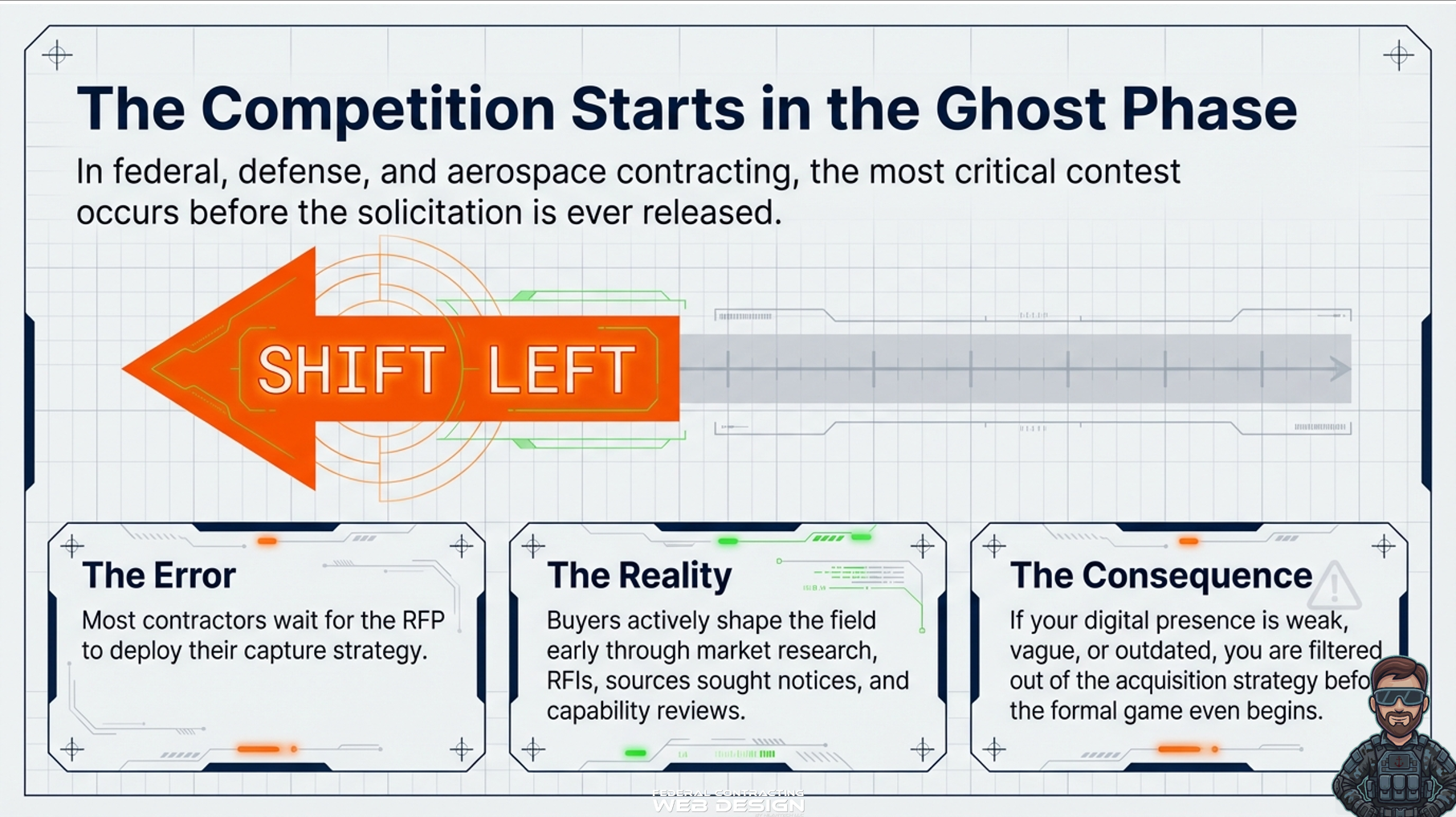
In federal, defense, and aerospace contracting, the competition often starts before the solicitation is released.
BLUF: In federal, defense, and aerospace contracting, the competition often starts before the solicitation is released. FAR Part 10 requires market research in many cases before agencies solicit offers, and GSA’s MRAS program explicitly tells industry that participating can increase visibility with government buyers. If your website is weak, vague, or outdated, you can lose ground during the research phase when buyers are deciding who looks credible, who looks capable, and who belongs in the acquisition strategy.
Most companies still act like the real contest begins when the RFP drops. That is wrong. In this market, buyers often start shaping the field earlier through market research, RFIs, sources sought notices, and capability reviews. FAR Part 10 says agencies must conduct market research before developing new requirements documents in many cases and before soliciting offers above the simplified acquisition threshold. It also says acquisitions begin with a description of the Government’s needs sufficient to allow market research. In plain English, buyers are studying the market before they write or release the formal opportunity.
That matters because early market research influences real downstream decisions. FAR Part 10 says agencies use market research results to determine whether capable sources exist, whether commercial solutions are available, whether small business programs should be used, and even how requirements might be structured. That means your company can be filtered out before proposal season if the agency cannot quickly understand your relevance, maturity, and delivery fit.
GSA makes the same point from the buyer side and the industry side. On its MRAS page, GSA says its market research reports include socio economic, technical, capabilities, and comprehensive business information used for acquisition planning, small business strategies, requirements, and estimate documents. GSA also tells industry partners that participating in MRAS helps them showcase products and services to potential buyers and can increase visibility in the market. That is not marketing fluff. That is the federal acquisition ecosystem telling you visibility happens before the RFP.
What this looks like in the real world
Here are real current examples from SAM.gov showing agencies performing market research before a formal solicitation.
There are also notices that explicitly ask for capability statements during this phase. One current Navy related notice for Logistics Support Services III says the capability statement package must be sent by email by the stated deadline. That means the Government is not waiting for the RFP to start judging who looks qualified.
The hard truth most contractors miss
When a contracting office, program office, or small business office looks at the market early, they are not reading your company the way you read your own website. They are scanning for signs of risk.
If your website makes them work to find those answers, you create friction. In a market where acquisition teams are moving fast and sorting through many vendors, friction kills attention.
How a website helps mitigate the problem
A good federal contractor website does not win the contract by itself. What it does is reduce uncertainty during the market research phase.
First, it translates your relevance fast. FAR Part 10 allows agencies to contact knowledgeable individuals and publish requests for information as part of market research. If your site clearly maps your capabilities to mission areas, platforms, agencies, and contract types, you make it easier for buyers to place you in the right mental category.
Second, it supports capability statement follow through. Since current notices often ask for capability packages, your website should reinforce what the capability statement claims. If the PDF says one thing and the site looks thin, stale, or generic, confidence drops.
Third, it helps shape teaming conversations. Many firms are discovered during the research phase not as obvious primes, but as potential niche partners, subcontractors, or surge capacity providers. A site that clearly explains where you fit in the stack makes you easier to pull onto a team.
Fourth, it strengthens credibility during small business and acquisition planning decisions. GSA says MRAS reports include business, technical, socio economic, and capability information used in planning. If your public digital footprint does not reflect a coherent, current, and professional business, you are harder to trust early.
What your website needs before the RFP
If you want to be taken seriously during market research, your website should answer six questions fast.
That means mission specific pages, clear capability language, real past performance framing, contract vehicle visibility, compliance content, leadership credibility, and a strong contact path for capture teams, contracting officers, and primes.
Final point
The federal market does not begin at solicitation release. It begins when the buyer starts asking, who is out there, who looks credible, who can actually do this, and who belongs in the acquisition strategy. FAR Part 10 makes that research phase real. GSA MRAS makes that visibility dynamic explicit. Current SAM.gov notices across Air Force, Space Force, Navy, and civilian buying activities show it happening right now.
If your website still reads like a generic brochure, you are not merely missing polish. You are missing the phase where buyers start deciding whether you even belong in the room.
Strategic Brief
Winning Before the RFP
Download PDF
Intelligence Briefing
"If your website makes them work to find those answers, you create friction. In a market where acquisition teams are moving fast and sorting through many vendors, friction kills attention."
Related Intelligence
Financial Analysis
The Hidden Fee Game Behind GoDaddy, Hostinger, Wix, and Similar Platforms
Operational Trust
The Other Guys vs HILARTECH Hosting
Strategic Analysis
The Hard Truth Behind the FY27 Defense Budget Surge
Operational Trust
The Defense Contractor Website Test No One Talks About